In-house designer, freelancer, or flat-rate design: what it really costs in Switzerland
When a startup or an SME reaches the point where it needs design on an ongoing basis, three options have traditionally been on the table. Hire freelancers. Recruit an in-house designer. Or hand projects to an agency, often at a steep price. Three models, each with its limits, and a fourth option most Swiss companies don't yet know about: flat-rate design.
Most founders pick one of these options by default, either because it's what they know, or because they haven't had time to really compare. This article is here to make that comparison properly, with the numbers, against the realities of the Swiss market in 2026.
What an in-house designer really costs in Switzerland
Let's start with the option that looks simplest on the surface: hiring.
A graphic designer with 3 to 5 years of experience in French-speaking Switzerland costs between CHF 5,500 and 7,500 gross per month. According to Glassdoor CH, a graphic designer's salary range generally sits between CHF 66,750 and 93,250 gross per year, or CHF 5,560 to 7,770 per month. For a senior profile, you're easily above CHF 7,000.
But gross salary is only the starting point. In Switzerland, employer social security contributions range from 10% to 20% of gross salarycovering old-age insurance (AVS), disability insurance (AI), loss-of-earnings compensation (APG), family allowances, and the occupational pension (LPP). On a gross salary of CHF 7,000, the employer pays roughly CHF 700 to 1,400 in additional contributions per month.
That brings the real payroll cost to around CHF 7,700 to 8,400 per month, before we've even mentioned the rest.
And what's the rest?
Recruitment first. Posting an ad, sorting applications, running interviews, negotiating the contract: easily count 4 to 8 weeks of process, often 2 to 3 months before the person is truly up and running. If you go through a recruitment firm, expect a commission of 15% to 25% of the gross annual salary.
Equipment next. A Mac workstation, Adobe Creative Suite licenses, project management tools, a workspace: between CHF 3,000 and 6,000 upfront, plus annual subscriptions.
Ongoing training. A good designer who doesn't keep learning is a designer who stalls. Courses, conferences, tools: CHF 1,000 to 2,000 per year at minimum.
Absences, finally. In Switzerland, an employee is entitled to at least 4 weeks of holiday per year, plus cantonal public holidays. Sickness, maternity or paternity leave: the design work stops, the costs don't.
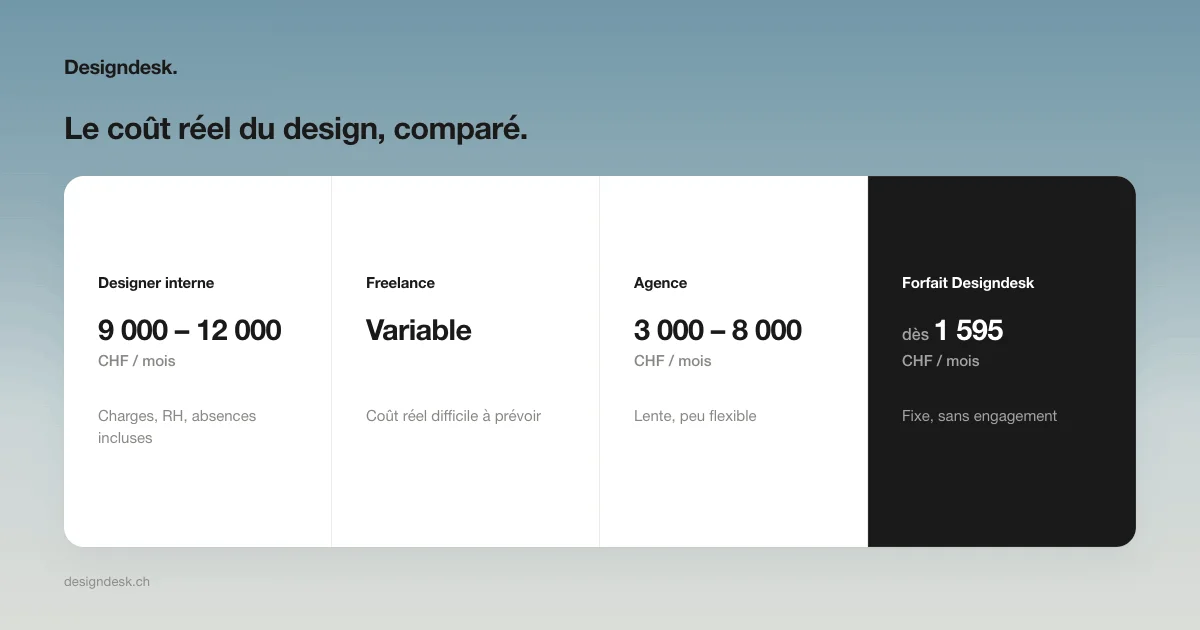
The real monthly cost of an in-house designer in Switzerland, all in: between CHF 9,000 and 12,000.
And that person covers only one area of expertise. If your SME needs branding, web design, and social media visuals all at once, a single profile often won't be enough.
What a freelancer really costs
The freelance option is appealing for its apparent flexibility. No social security contributions, no long-term commitment, you pay when there's work. In theory.
In practice, freelance graphic designer rates in French-speaking Switzerland run between CHF 120 and 180 an hour depending on experience and specialty. A full branding project (logo, brand guidelines, applications) comes to, according to Kinomebetween CHF 4,000 and 15,000. A website, between CHF 3,000 and 12,000.
These figures are accurate. But they don't tell the whole story.
The cost of friction
Working with a freelancer means managing a vendor relationship on top of running your business. It means detailed briefs for every assignment, because the freelancer doesn't know your brand world by heart. Email back-and-forth over questions that would have taken 30 seconds in-house. Deadlines that slip when the freelancer has other, higher-priority clients. And sometimes, difficult communication, because not every freelancer is trained in client relations.
This coordination time is real. If a founder or a marketing lead spends 3 to 5 hours a week managing design vendors, at CHF 150 an hour (the real cost of their time), that's between CHF 1,800 and 3,000 per month going into pure management, without a single visual being produced.
Discontinuity
A freelancer can be unavailable. They can fall ill, go on holiday, decide to change direction. If you've built a working relationship over 6 months and they disappear, you start from scratch with someone else. Re-briefing, re-onboarding, recalibrating the visual style.
Billing project by project
The per-project model is psychologically hard to manage for a growing SME. Every new visual, every deck update, every banner request triggers a new quote, a new negotiation, a new wait. You end up postponing requests to avoid the administrative friction, and design shifts into reactive mode rather than proactive.
What an agency really costs
An agency is reassuring. A team, a single point of contact, a structure. But that peace of mind comes at a price.
According to Anorac Studio, a full visual identity handled by an agency in French-speaking Switzerland runs between CHF 4,000 and 15,000. A website, between CHF 3,000 and 12,000. And for recurring outsourced design production, monthly packages for SMEs generally range between CHF 3,000 and 8,000 per month..
Then there are the timelines. An agency handles several clients in parallel. Your project waits its turn. The back-and-forth goes through a project manager. The slightest change triggers a change order or a discussion about scope.
For an SME that needs responsiveness and volume, the traditional agency model is often too slow and too expensive for what it delivers day to day.
What a flat-rate design subscription really costs
The flat-rate model is still little known in Switzerland. That's precisely why we created Designdesk.
The principle: a fixed monthly rate, unlimited requests, unlimited revisions, no long-term commitment. At Designdesk, entry is CHF 1,595 per month.
But beyond the headline price, what really changes with a subscription is how design is framed within the company.
Complete predictability
No quotes. No surprise at the end of the month. No project overrunning its estimated budget because there were two more rounds of revisions than planned. You know exactly what you're paying, and you can plan accordingly.
A team that knows your brand
Unlike the freelancer you re-brief for every assignment, a subscription team absorbs your visual world over time. The second and third months produce better, faster design than the first, because knowledge accumulates.
Flexibility without the precariousness
Need to pause for a month because money's tight? You can. Need to speed up because you're launching a product? You submit more requests. The subscription adapts to your pace without renegotiating a contract.
Zero social charges, zero HR management
No employment contract, no social security to manage, no notice period to observe if needs change. The relationship is clean and simple.
The real comparison, side by side
Here's what it looks like in concrete terms for a Swiss SME with regular design needs:
In-house designer (experienced profile) Real monthly cost: CHF 9,000 to 12,000 Time to operational: 2 to 3 months Skill coverage: 1 profile, 1 core expertise Flexibility: near zero, 1 to 3 months' notice Risk: sick leave, departure, empty recruitment periods
Freelance Real monthly cost: variable, hard to predict Delivery time: depends on availability Skill coverage: 1 profile, availability not guaranteed Flexibility: good on paper, hard to manage in practice Risk: discontinuity, uneven quality, underestimated coordination time
Traditional agency Real monthly cost: CHF 3,000 to 8,000 for recurring production Delivery time: slow, multiple contacts Skill coverage: broad but billed per project Flexibility: low, contracts often span several months Risk: high cost, limited responsiveness
Designdesk subscription Real monthly cost: from CHF 1,595, fixed Time to operational: immediate Skill coverage: multidisciplinary team Flexibility: can be paused, no commitment Risk: near zero
Who the subscription isn't for
It would be dishonest not to say it: flat-rate design isn't the right solution for everyone.
If you have a single large one-off project to deliver (a full website redesign, an identity created from scratch, a campaign with video production), the one-off project with an agency or a senior freelancer is often the better fit. The subscription is made for companies with recurring needs: regular visuals, content to refresh, materials to update, communication to sustain over time.
It's also less relevant if you don't yet have a clear strategic direction for your brand. A subscription produces design, but it doesn't replace the positioning and strategy work that has to come first.
What this says about the Swiss market
Switzerland is a market where everything is expensive. Salaries are high, social charges are real, and agencies pass their fixed costs on to clients. In that context, SMEs and startups are often stuck between two extremes: too small to hire, too active to make do with an occasional freelancer.
Flat-rate design has existed for a few years in English-speaking markets. In French-speaking Switzerland, it's still little known. Many companies keep paying agencies per service because they don't know an alternative exists, or because they think it's reserved for large organizations.
It isn't. This model was designed precisely for growing organizations, the ones with too many needs for a freelancer and not enough budget for an agency or a hire.
Want to see whether a design subscription fits your situation? Book a 15-minute call and we'll take a look together.
Frequently asked questions
What is the average cost of a graphic designer in Switzerland in 2026?
An experienced graphic designer costs between CHF 66,750 and 93,250 gross per year according to Glassdoor, or CHF 5,560 to 7,770 per month. Adding social charges (10% to 20% of gross salary) and ancillary costs (equipment, training, absences), the real cost to the employer sits between CHF 9,000 and 12,000 per month.
How much does a freelance graphic designer cost in French-speaking Switzerland?
Hourly rates generally sit between CHF 120 and 180 an hour depending on experience and specialty. A full branding project can cost between CHF 4,000 and 15,000. On top of that headline rate comes the invisible cost of management: briefs, back-and-forth, coordination, between CHF 1,800 and 3,000 per month in founder time.
How much does a communications agency cost in French-speaking Switzerland?
For recurring outsourced design production, monthly packages for SMEs generally range between CHF 3,000 and 8,000 per month. A one-off project (visual identity, website) sits between CHF 3,000 and 15,000 depending on scale.
What is a flat-rate design subscription and how much does it cost?
A flat-rate design subscription is a design service billed at a fixed monthly rate, with unlimited requests and revisions and no long-term commitment. In Switzerland, Designdesk offers this model from CHF 1,595 per month, up to 70% cheaper than an in-house designer.
Is flat-rate design suited to Swiss startups?
Yes, particularly. Growing startups have regular but variable design needs, and can't always afford an in-house designer. The subscription gives them an operational team immediately, with the flexibility to pause if needed.
Sources Glassdoor CH — Salaires Graphic Designer en Suisse jobs.ch — Salaires Graphiste en Suisse Karpeo — Charges sociales et taux en Suisse 2026 Kinome — Tarifs agence communication Genève 2026 Anorac Studio — Combien coûte une agence de communication en Suisse romande Pixelium — Agence communication visuelle : externaliser en 2025