The agency wins the project. The client is happy, the budget is signed, the strategy is approved. Then the list of deliverables lands. A visual identity to roll out, a website, forty visuals for six months of social media, two brochures, event signage.
The agency has a strategist, a project manager, an account lead, and an excellent little black book. What it doesn't have is a designer.
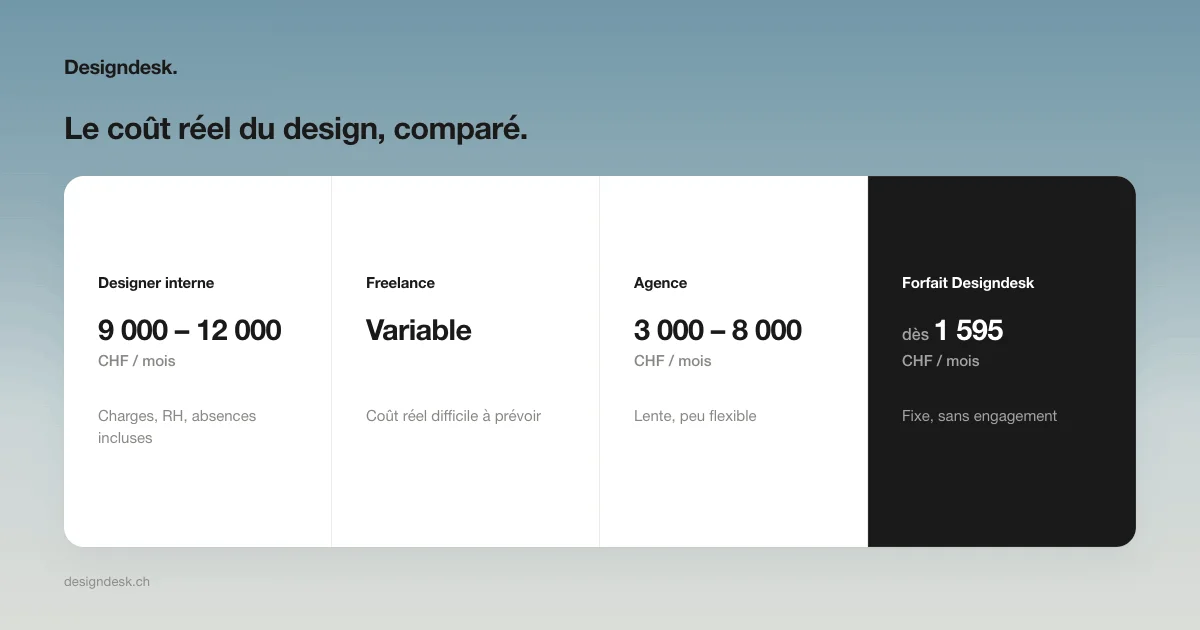
This is the norm, not the exception. A large share of communications agencies in French-speaking Switzerland have their design produced externally. Some by choice, because their value lies in strategy, not execution. Others out of necessity, because an experienced designer costs between CHF 9,000 and 12,000 per month all-in, and no ten-person agency can guarantee keeping one busy twelve months a year.
What's strange is that almost no one writes about it. There is virtually no serious resource, in French, on white-label creative outsourcing. As a result, every agency reinvents its own rules, negotiates its terms case by case, and discovers the problems only once they've arrived.
This article tackles the subject head-on. The costs, the real margin, file ownership, the risk of disintermediation, what happens if the end client finds out about the arrangement, and the situations where white-label is a bad idea.
Why communications agencies outsource their design production
Three reasons come up every time.
The peak. An agency's workload is never constant. It wins a pitch and has to produce three times as much for six weeks, then it drops back down. Hiring for a peak is impossible. Turning the project down hurts. Pulling sixty-hour weeks works once, not three times.
The specialty. Design isn't one job, it's five. A brand identity, a website, packaging, and an investor deck don't call for the same instincts. An in-house designer covers one core specialty, rarely more.
The business model. A strategic communications agency sells advice, brand thinking, planning, coordination. Its margin lives in the thinking and in the client relationship. Bringing design execution in-house means adding a heavy fixed cost to a business whose value lies elsewhere.
So it's not an admission of weakness. It's a structural decision, exactly like an agency that doesn't run its own printing in-house.
What white-label design actually means
White-label means the studio produces and the agency delivers. The studio never appears in the relationship with the end client. It doesn't sit in on client meetings, doesn't invoice the end client, and doesn't sign off the deliverables.
Here's how it works with us, in practice. The agency is our client, and our only client. It briefs, it approves, it delivers to its own client. Everything runs through a shared project board. If the agency chooses to give its end client access to it, that's its call, not ours, and it works perfectly well. If it prefers to remain the sole point of contact, that's the default.
What separates true white-label from plain outsourcing is discipline on three points: who talks to the client, who owns the files, and what the studio is allowed to say publicly. Everything else is comfort. These three points are what make a collaboration hold together or blow apart.
What white-label design production costs in French-speaking Switzerland
Three models coexist.
The freelancer, per project. Between CHF 120 and 180 an hour in French-speaking Switzerland. Flexible on paper, unpredictable in practice. The real cost isn't the hourly rate, it's the coordination time and the risk of them being unavailable at the worst possible moment.
The creative studio, per project. A full visual identity runs between CHF 4,000 and 15,000, a website between CHF 3,000 and 12,000. In line with the market, but every request triggers a quote, a negotiation, and a wait. For an agency that has to deliver fast, this is the highest-friction model.
The monthly subscription. A fixed amount, unlimited requests, unlimited revisions, no fixed term. At Designdesk, entry is CHF 1,595 per month for one request handled at a time, and CHF 1,000 per additional concurrent request, capped at three parallel requests per client.
That cap isn't commercial, it's about quality. Beyond three projects running at once for the same contact, consistency slips and deadlines drift. We'd rather say so upfront.
For context: an agency running three requests permanently pays CHF 3,595 per month. That's below the cost of a junior in-house designer, for a multidisciplinary team available immediately, with no hiring, no payroll charges, and no notice period.
We break down the full cost comparison in our article on the real cost of an in-house designer, a freelancer, and a subscription in Switzerland..
What margin an agency actually makes by outsourcing
It's the question everyone asks and no one asks out loud. Let's take it seriously.
An agency billing a client CHF 8,000 for a visual identity, within a market range of 4,000 to 15,000, spends roughly one month of design production on that project. With an in-house designer, the real production cost sits around CHF 9,000 to 12,000 a month, and the project alone doesn't fill the month. With a monthly subscription at CHF 1,595, the production cost of the same deliverable is known, fixed, and a fraction of the billed budget.
The gap isn't only about this one project. It's about structure. A low, predictable fixed cost lets an agency say yes to projects it would have turned down, offer additional deliverables without reopening a negotiation, and issue quotes without having to build in a safety margin for execution.
One honest caveat: this margin isn't free. It's paid for in coordination. A poor brief produces a useless deliverable, whatever the provider. The agency that truly makes money by outsourcing is the one that invests in the quality of its briefs.
One request isn't one request: how it holds up across several clients
It's the most common objection, and the most legitimate. An agency juggling eight accounts wonders how a system with one or three active requests can keep up.
The answer lies in what requests really look like. In an agency's real life, there aren't three visual identities to create on the same Monday. There's one identity in progress, some flyer copy to fix, a business card to prep for print, a banner to adapt into three formats. These requests don't draw on the same thing.
On top of that comes a reality everyone knows and no one factors into their math: approval time. A deliverable goes to the end client and waits two days, sometimes five. Meanwhile, production continues on something else. A well-managed queue moves without interruption, precisely because it's sequenced.
The average time to a first proposal is about five business days on a standard request. A full identity or a website obviously isn't delivered in five days, and we set those timelines case by case rather than promising an average that means nothing.
Who owns the source files
Source files are handed over, no debate, no surcharge, on request.
This deserves to be stated plainly, because market practice is far from uniform. Some studios keep the source files, others charge for them at the end of a project, others still hand them over in a format that isn't genuinely editable.
For an agency, this is a survival issue. It has to be able to adapt, correct, extend, and keep serving its client even if the collaboration with the studio ends. A provider who withholds the files isn't selling design, it's selling dependency.
Can the subcontractor go around the agency
This is the underlying fear, rarely spoken. The agency brings in a client, the studio gets to know them, and twelve months later the client is working directly with the studio.
Our rule is simple. Our client is the agency. We don't solicit its clients, during or after. We never reach out to them on our own initiative. If an end client contacts us directly mid-project, we send them back to the agency.
This rule isn't generosity, it's economic common sense. An agency that trusts us brings us several projects a year for years. An end client poached once is one project and a wrecked reputation in a market where everyone knows everyone. The math is easy.
That said, a rule is only worth the contract that carries it. It has to be in writing.
What happens if the end client finds out about the arrangement
Let's be clear: white-label isn't a secret, it's an arrangement.
In most cases, the end client suspects it or knows it, and it's a non-issue. What they buy from their agency is strategy, an understanding of their market, coordination, and accountability for the result. That the design execution is produced by a specialized team is good news for them, not bad.
The problem only arises when the agency has explicitly promised in-house production. It's that promise that creates the risk, not the outsourcing itself.
Communication and confidentiality: our rule
We keep the right to showcase the work we produce, no earlier than three months after delivery.
If an agency wants total silence, the option exists at CHF 500 per month. The reason is straightforward: our portfolio is part of how we're paid. When we give up showing a piece of work, we give up something of value, and that's compensated.
We'd rather state this price publicly than negotiate it case by case. It's healthier for everyone.
What if the need is one-off?
You might think a monthly subscription only makes sense for recurring needs. It doesn't, and the math is quick.
A website redesign billed between CHF 3,000 and 12,000 per project works out, in our model, to two months of subscription. That's CHF 3,190, unlimited revisions included, no quote, no change order, no argument about scope. Once the project is done, the agency pauses or stops. Nothing keeps ticking.
In other words, even on a single project, the subscription is often the cheapest option on the market. Recurrence isn't a condition, it's a bonus.
When white-label isn't the right solution
It would be dishonest to present this model as universal.
If you need more than three heavy projects running permanently. An agency that has to run five identities at once all year has reached the size where an in-house team makes sense. Our cap of three concurrent requests exists to protect quality, not to be worked around.
If your agency sells in-house production as a selling point. Some agencies have built their positioning on an integrated creative team. Outsourcing contradicts their promise. That's a legitimate strategic choice, it simply has to be owned all the way, with the fixed cost that comes with it.
If you're looking for brand art direction rather than production. A subscription produces design. It doesn't replace the positioning and brand-platform work, which remains the agency's value.
If the strategic direction isn't settled. Reading between the lines is part of the job, and a request phrased in three sentences is plenty for us. But if no one has decided what the brand says or who it speaks to, no designer can decide it for you. That's the agency's job, and it's precisely what stays with the agency.
What we learned in a year with a French-Swiss communications agency
We've been working white-label for a year with a communications agency in French-speaking Switzerland. The agency keeps the strategy, the advice, and the client relationship. We produce.
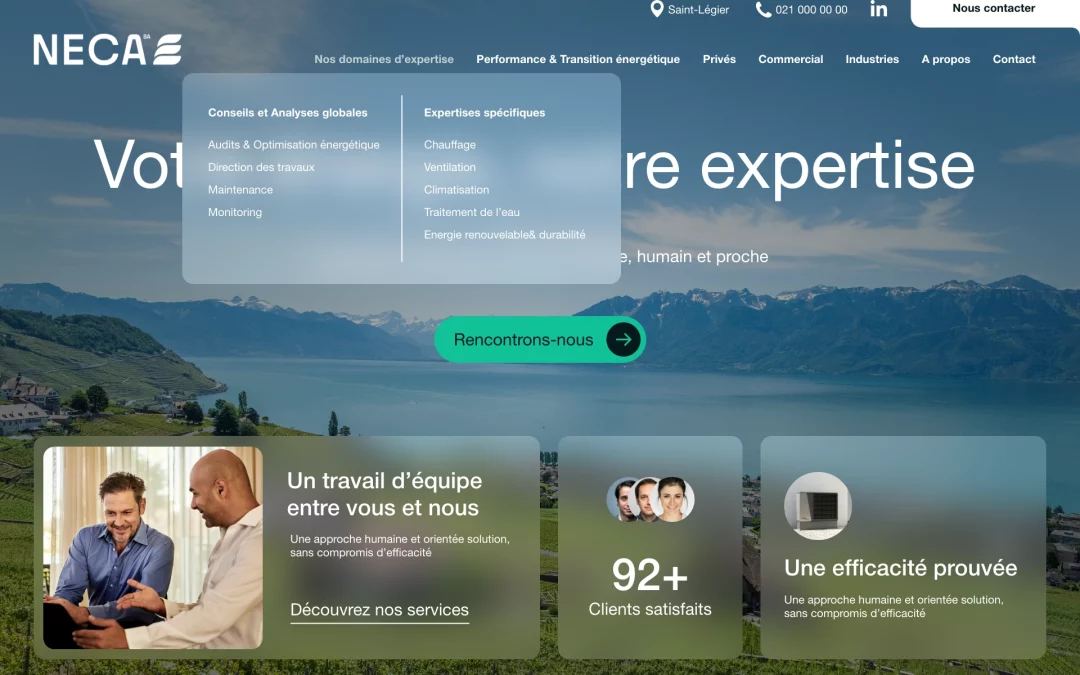
Over a year, the collaboration covered sixteen end clients, plus the agency itself. A municipality, an energy company, industrial SMEs, local shops and services, an association, sole traders. Very few comparable projects, many different contexts, which is exactly the reality of a generalist communications agency.
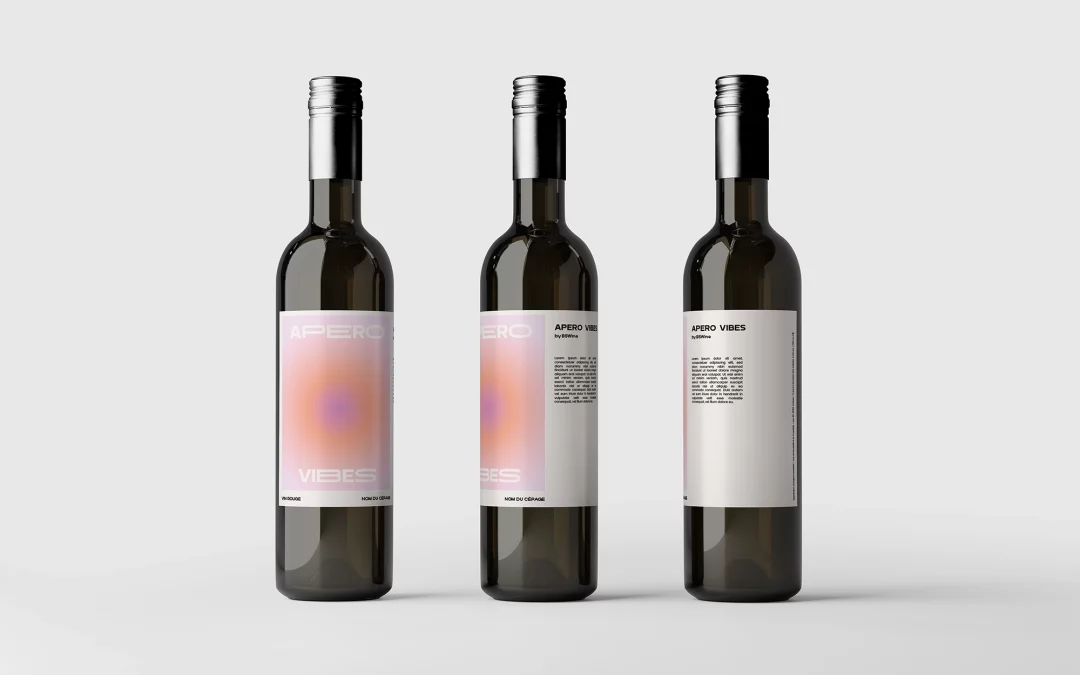
In volume, that's six visual identities, three brand-world overhauls, and fifteen websites, from a few-page brochure site to a multilingual one, plus a continuous flow of print materials, adaptations, and updates. It's that flow, more than the big projects, that makes the monthly model make sense for an agency.
What this year showed: the first two months are the heaviest, because you have to settle the codes, the briefing habits, and the channels. From the third month on, production speeds up markedly, for one simple reason, knowledge accumulates. It's the exact opposite of a freelance relationship you restart with every assignment.
How to get started
If you run a communications agency and design production is your bottleneck, the fastest test is a real project, not a theoretical discussion.
The subscription starts at CHF 1,595 per month, no commitment, with the option to pause or cancel anytime. In other words, the cost of trying is low, and the cost of continuing to turn down projects isn't.
Book a 15-minute call and we'll look at your situation in concrete terms.
Frequently asked questions
What is white-label design for a communications agency?
It's a model where a studio produces the design deliverables and the agency delivers them under its own name. The studio takes no part in the relationship with the end client, doesn't invoice them, and doesn't appear on the deliverables. The agency keeps the strategy, the advice, and accountability for the result.
What does white-label design outsourcing cost in French-speaking Switzerland?
Three models coexist. The freelancer per project, between CHF 120 and 180 an hour. The studio per project, between CHF 4,000 and 15,000 for a visual identity and between CHF 3,000 and 12,000 for a website. The monthly subscription, from CHF 1,595 per month at Designdesk, with CHF 1,000 per additional concurrent request.
Can an agency run several clients on a single subscription?
Yes. The subscription covers an unlimited number of brands and requests, handled in sequence. An agency can open up to three parallel requests, at CHF 1,000 per additional concurrent request. In practice, an agency's requests vary widely in size, and client approval times create natural breathing room in the queue.
Are the source files handed over to the agency?
Yes, and at no extra cost. The agency has to be able to adapt, correct, and keep serving its client independently, including if the collaboration ends.
Can the studio contact the agency's end client directly?
No. The client is the agency. There's no soliciting of the end client, during or after the collaboration. If an end client makes direct contact during the project, they're sent back to the agency. The only exception is access to the shared project board, which the agency itself decides on.
Can the studio publicize the projects it produces?
Yes, no earlier than three months after delivery. The agency is never named without its consent. A total confidentiality option is available at CHF 500 per month.
Is it a subscription with a commitment?
No. Billing is monthly, with no fixed-term contract. The subscription can be paused or stopped at any time.
Sources
Glassdoor CH, salaires Graphic Designer en Suisse
Kinome, tarifs agence communication Genève
Anorac Studio, combien coûte une agence de communication en Suisse romande